
RESEARCH THEME
Fairness & Bias
One of our main focuses is fairness and bias in AI for medical image analysis.
OUR WORK IN FAIR AI
Fairness in CMR segmentation
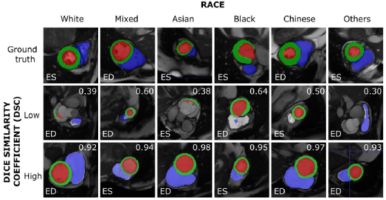
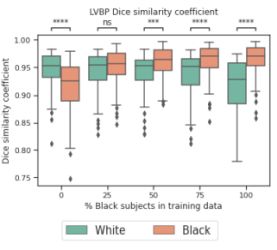
In many computer vision applications, artificial intelligence (AI) models have been known to exhibit bias in performance against protected groups that were underrepresented in the data used to train them. In this work we investigated whether AI semantic segmentation models could also exhibit such bias. We trained AI models for the task of segmenting the chambers of the heart from short axis cine cardiac MR images, and found significant racial bias in performance against minority races. This bias could potentially lead to higher misdiagnosis rates for heart failure, which is typically based on the patient's ejection fraction, as estimated from segmentations of the cardiac structures from cardiac MR.
Publications:
- "An Investigation Into the Impact of Deep Learning Model Choice on Sex and Race Bias in Cardiac MR Segmentation" Proceedings MICCAI FAIMI, 2023. paper
- "A Systematic Study of Race and Sex Bias in CNN-based Cardiac MR Segmentation" Proceedings MICCAI STACOM, 2022. paper
- "Fairness in Cardiac Magnetic Resonance Imaging: Assessing Sex and Racial Bias in Deep Learning-Based Segmentation" Frontiers in Cardiovascular Medicine, 2022. open access paper
- "Fairness in Cardiac MR Image Analysis: An Investigation of Bias Due to Data Imbalance in Deep Learning Based Segmentation" Proceedings MICCAI, 2021. paper
Subsequent work has attempted to uncover the root causes of this bias. Through a series of carefully-designed experiments we were able to discover that most of the distributional shift between White and Black subjects' CMR images (which can lead to bias) stems from areas outside the heart, such as subcutaneous fat. This knowledge opened up the possibility to design a new "understanding-informed" method for bias mitigation, which resulted in improved segmentation performance for both White and Black subjects with no accuracy-fairness trade-off.
Publications:
- "Understanding-informed Bias Mitigation for Fair CMR Segmentation" Machine Learning for Biomedical Image Analysis, 2026. paper
- "Does a Rising Tide Lift All Boats? Bias Mitigation for AI-Based CMR Segmentation" Proceedings MICCAI FAIMI, 2025. paper
- "An Investigation Into the Causes of Race Bias in AI-based Cine CMR Segmentation" European Heart Journal Digital Health, 2025. paper
Fairness in brain MR analysis
We investigated the potential for bias in the brain MR segmentation task. We systematically varied the level of protected group imbalance in the training set of a FastSurfer segmentation model and observed both sex and race bias in the resulting model performance. The bias was localised to specific regions of the brain and was stronger for race (white vs black) than sex.
Publications:
- "A Study of Demographic Bias in CNN-based Brain MR Segmentation" Proceedings MICCAI MLCN, 2022. paper
We have also investigated different sources of bias in AI based unsupervised anomaly detection (UAD) from brain MR. UAD involves training an AI model to learn the normal distribution of a training set. Subsequently, any sample outside of this distribution is considered to be abnormal, or an anomaly. However, previous work has assumed that there were no other sources of domain shift that could cause the abnormality. In this work, we found that both race and sex, as well as MR scanner vendor, could lead to such shifts, and UAD models trained using imbalanced data could exhibit biases in a similar way to supervised models.
Publications:
- "Bias in Unsupervised Anomaly Detection in Brain MRI" Proceedings MICCAI FAIMI, 2023. paper
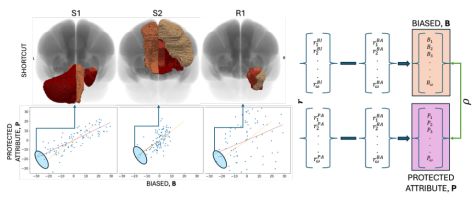
AI has been proposed for diagnosing Alzheimer's disease from brain MR. We have investigated if such models can learn demographic-related shortcuts and hence exhibit biased behaviour. We found that AI could identify both race and sex from brain MR images with a high level of accuracy and that the features exploited for this task could act as shortcuts when training for Alzheimer's disease diagnosis with race or sex imbalanced training sets. A method for quantitatively analysing the severity and nature of this shortcut learning was proposed.
Publications:
- "Invisible Attributes, Visible Biases: Exploring Demographic Shortcuts in MRI-Based Alzheimer's Disease Classification" Proceedings MICCAI FAIMI, 2025. paper
Fairness in prostate MR segmentation
As well as CMR and brain MR segmentation, we have also investigated the potential for race bias in AI-based prostate segmentation from MR imaging. Here, we found a smaller, but still significant race bias effect — when training with data acquired from White subjects the model showed significant bias in performance against Black subjects. Publicly available datasets of prostate MR images do not provide information about the race of their subjects, but they are likely racially imbalanced, so this raises concerns about possible biases in AI segmentation models trained using these data.
Publications:
- "An Investigation of Race Bias in Deep Learning-based Segmentation of Prostate MRI Images" Scientific Reports, 2025. paper
Fairness in breast cancer characterisation
There has recently been increasing interest in the use of AI to determine characteristics of tumours from radiological images. We have investigated the use of AI for determining breast tumour molecular subtype from dynamic contrast enhanced MR images (DCE-MR). We found that a random forest model trained with radiomics features was able to classify the race of the subject from such data (White vs Black) and furthermore that models for predicting tumour subtype could exhibit race bias when trained with imbalanced data.
Publications:
- "An Investigation Into Race Bias in Random Forest Models Based on Breast DCE-MRI Derived Radiomics Features" Proceedings MICCAI FAIMI, 2023. paper
Fairness in dermatology image analysis
In dermatology, bias by skin tone is a well-known phenomenon: when training AI skin lesion diagnosis models using data from mostly light-skinned subjects, the resulting model will be biased against dark-skinned patients. In these studies, the Fitzpatrick Skin Tone (FST) scale is commonly used to represent skin colour. In this work we specifically investigated the impact that the granularity of FST values has on efforts to eliminate this bias. We found that dark-skinned patients have more coarse granularity in FST values than light-skinned patients and that this disparity negatively impacts the performance of AI models.
Publications:
- "The Impact of Skin Tone Label Granularity on the Performance and Fairness of AI Based Dermatology Image Classification Models" Proceedings MICCAI FAIMI, 2025. paper
FAIMI Initiative
Prof King and Dr Puyol-Antón are founding members and organisers of FAIMI, an independent academic initiative aimed at promoting research into Fairness of AI in Medical Imaging. FAIMI holds an annual free online symposium to showcase the best and latest research into Fair AI in medical imaging. They also run a workshop at the MICCAI conference. Check out the FAIMI web site for recordings of events, details of future events and useful resources on fairness research.

Interested in our work?
Explore our research or get in touch with the group.
Contact the group →