
RESEARCH THEME
Prediction
This strand of our AI work aims to predict the future state of the patient, including risk prediction, response to treatment, and toxicity arising from treatment.
OUR WORK IN PREDICTION
Predicting response to cardiac resynchronisation therapy
Cardiac resynchronisation therapy (CRT) is a treatment for heart failure which involves implanting a pacemaker into the heart to restore electrical and mechanical synchrony. This procedure is invasive and not without risk, but approximately 30-50% of patients do not respond positively to the treatment. Therefore, there is interest in predicting which patients are likely to respond using pre-treatment imaging data. Over the years we have proposed a number of frameworks to address this problem, starting with classical machine learning approaches and progressing to the latest deep learning methods. Along the way, we have addressed the issues of interpretability and trust in the models with a view to developing an AI model for CRT response prediction which could act as a decision support tool for cardiologists.
Publications:
- "A Multimodal Deep Learning Model for Cardiac Resynchronisation Therapy Response Prediction" Medical Image Analysis, 79:102465, 2022. open access paper
- "Uncertainty-Aware Training for Cardiac Resynchronisation Therapy Response Prediction" Proceedings MICCAI STACOM, 2021. paper, presentation
- "Interpretable Deep Models for Cardiac Resynchronisation Therapy Response Prediction" Proceedings MICCAI, 2020. paper
- "A Framework for Combining a Motion Atlas with Non-Motion Information to Learn Clinically Useful Biomarkers: Application to Cardiac Resynchronisation Therapy Response Prediction" Medical Image Analysis, 35:669-684, 2017. open access paper
Predicting toxicity in radiotherapy
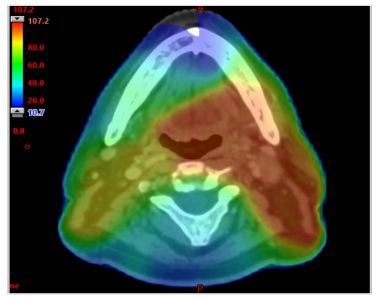
Mandible osteoradionecrosis (ORN) is one of the most severe toxicities in patients with head and neck cancer undergoing radiotherapy. Previous literature has focused on examining correlations between mandible ORN and clinical and dosimetric factors. In this work, for the first time we investigated the use of machine learning methods to make personalised predictions of mandible ORN incidence.
Publications:
- "External Validation of a Multimodality Deep-learning Normal Tissue Complication Probability Model for Mandibular Osteoradionecrosis Trained on 3D Radiation Distribution Maps and Clinical Variables" Physics and Imaging in Radiation Oncology, 2024. paper
- "Comparison of Deep-learning Multimodality Data Fusion Strategies in Mandibular Osteoradionecrosis NTCP Modelling Using Clinical Variables and Radiation Dose Distribution Volumes" Physics in Medicine and Biology, 2024. paper
- "Prediction of Mandibular ORN Incidence From 3D Radiation Dose Distribution Maps Using Deep Learning" Proceedings MICCAI AMAI, 2022. paper
- "Comparison of Machine Learning Methods for Prediction of Osteoradionecrosis Incidence in Patients With Head and Neck Cancer" British Journal of Radiology, 2021. paper
Interested in our work?
Explore our research or get in touch with the group.
Contact the group →